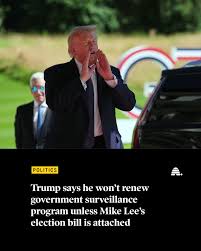



Trump wants Save Act Attached to Reauthorization of National Security Surveillance Program and now the Affordable Housing Act which he refuses to sign despite being passed by Congress unless SAVE Act is passed.
The Senate did not pass the Save Act and Trump in March did an executive order that prohibits non citizens from registering or voting (already a law), Homeland Security will have to compile and transmit to him the confirmed individuals qualified to vote by State prior to Federal elections, the USPS now has to ensure that each absentee ballot has to have a bar code on the envelope and not transmit a ballot from any individual unless they are the enrolled state specific list (how are they going to pay for that since they are in the red already and suspending pension payments), if there is a state issue the Federal government can withhold Federal funds and localities.
So now Trump is still trying to get Congress to pass the Save Act by attaching it to the reauthorization of the National Security Surveillance Program.
This all goes back to the Biden election and January 6th where he lost the election. Trump lost every lawsuit regarding voting results in the 2020 election. Learn more Additionally, he lost the popular vote in 2016 and only became president because of the electoral college, not the popular vote. So, of 3 elections, he won the popular vote once.
Key Provisions of the SAVE America Act (2026)
- Documentary Proof of Citizenship:Individuals must provide specific documentation (passport- cost of $165, birth certificate, or REAL ID-compliant ID) showing U.S. citizenship to register to vote in federal elections.
- Married Women.Around 80% of American women change their name upon marriage. As a result, roughly 33% of all married women lack documents that meet citizenship requirements and reflect their current legal name. Married women make up over a quarter of the electorate, so impeding them from registering to vote has a potentially significant impact on election outcomes.
- Photo ID Requirement:Voters must present a valid, government-issued photo ID to vote in person.
- Elderly registrants.In 2020, 14.10% of survey respondents 80 years old and older reported that they lack access to documents proving citizenship. In 2022, older voters (defined as age 65+) were 28% of the electorate.
- Young voters.In the same study, 24.34% of 18-29 year olds reported that they lacked documentation. State-level data matched that finding. Young Texans aged 18-29 are three times more likely to have trouble accessing their documentary proof of citizenship than older Texans (13% vs. 5%). Georgians aged 18-29 are twice as likely to lack access to documents than those 30 or older (16% vs 8%).
- Lower-income voters.In Texas and Georgia, voters making less than $50,000 per year are less likely to possess identity documents than their higher-income peers. Voters making less than $30,000 per year are even less likely to have required documents.
- Mail-In Ballot Restrictions:Applicants for mail-in ballots must submit a copy of their citizenship document, and some interpretations suggest in-person presentation of documents may be required even for mail-in registration.
- Voter Roll Maintenance:States are required to establish programs to identify and remove non-citizens from existing voter registration records using Department of Homeland Security data.
- Penalties for Officials:The Act introduces criminal penalties for election officials who fail to enforce the strict documentation requirements.
- Alternative Citizenship Process:States must create an alternative, albeit strict, process for individuals who cannot immediately provide documentary proof.
- Current Laws Make it Illegal to vote for Non-US Citizens
- Federal lawalready clearly states that it is illegal for non-U.S. citizens to register to vote or cast a ballot in federal elections. It’s an existing crime that is punishable by up to five years in prison.
- Election officialsalso already use state and federal data—including citizenship data from the S. Department of Homeland Security and the Social Security Administration—to verify an individual’s eligibility to cast a ballot.
- There are already documentation requirements to be able to register to vote. As required by federal law, Americans must provide either the last four digits of their Social Security number or their driver’s license number on a voter registration application in order to provide election officials with the necessary information to verify their identity and voting eligibility.